Location: Home >> Detail
J Sustain Res. 2026;8(2):e260056. https://doi.org/10.20900/jsr20260056
 ,
Abdullah Al Masud 3,4 ,
Md Tarikul Islam 5 ,
Mohammad Bin Amin 6,7,* ,
Amani AbdAlatti 8 ,
Parul Akhter 9,* ,
Abdul Rahman bin S Senathirajah 1,10,11 ,
Ján Dvorský 12,13
,
Abdullah Al Masud 3,4 ,
Md Tarikul Islam 5 ,
Mohammad Bin Amin 6,7,* ,
Amani AbdAlatti 8 ,
Parul Akhter 9,* ,
Abdul Rahman bin S Senathirajah 1,10,11 ,
Ján Dvorský 12,13
1
2
3
4
5
6
7
8
9
10
11
12
13
*
This study examines the relationship between green human resource management (GHRM) and environmental performance (EP) using data from large Bangladeshi industrial businesses. This empirical study examined 394 Bangladeshi corporate workers, and structural equation modeling was used to analyze the survey and questionnaire results. Through GHRM, companies can maintain EP. We find that some of the best ecological performance for mediating GHRM and EP include employee eco-friendly behavior, GIC, and pro-environmental behavior (PEB). For optimal EP, general directors of industrial organizations and representatives should use the current resource-based view theory to achieve and manage GHRM, employee eco-friendly behavior, green intellectual capital (GIC), and PEB. Broad research will help directors and managers of large industrial sectors support internal strategies to improve EP, such as GHRM, employee eco-friendly behavior, GIC, and PEB. This will aid directors, managers, executives, and lawmakers in decision-making.
HR, human resource; GHRM, green human resource management; EP, environmental performance; PEB, pro-environmental behavior; GIC, green intellectual capital; RBV, resource-based view theory; SCT, social cognitive theory; HRM, human resource management; SEM, structural equation modeling; GI, green innovation
In the past few decades, protecting the natural environment (hereinafter, environment) has been a major concern globally, and environmental issues are increasing. Almost all firms protect the environment. Product waste has been reduced by most manufacturers, making them run better businesses [1]. Sustainable practices and environmental protection are an organization’s primary priorities [2]. Eco-friendly human resource (HR) management (HRM) is attracting the attention of both academics and professionals [3]. For years, HRM specialists have studied how green HRM (GHRM) helps organizations achieve environmental goals. GHRM practices support a company’s mission and environmental concerns [4]. It ensures a company’s environmental lifespan [5]. Green innovation (GI) and GHRM are being investigated to establish a competitive market strategy that supports both environmental and organizational success.
GHRM promotes environmentally responsible behavior in employees to make the workplace more sustainable [6]. Production, waste, culture, values, strategies, and employee behavior affect supply chain and environmental performance (EP) [7]. Employment, remuneration, awards, and termination simplify green policies [8]. Business and government leaders have used GHRM studies to establish environmentally and socially responsible companies. The organizational impacts of GHRM have dominated GHRM research [9,10]. Hire-related HRM practices may be green. Connection detection may be complicated by options. Research suggests that GHRM may help Bangladesh’s ecology.
Intellectual capital information, talents, experiences, and other intangible assets add value to a company, but it has not been researched. It depicts a company’s smart and creative employees, providing the company with an edge over competition. GHRM and GIC are new, so additional study is needed [11]. GHRM study should examine the effect of intellectual capital on long-term performance [12]. Previous research has examined GIC [13]. Faeni et al. (2025) [14] suggested studying GIC and its environmental effects. Academics and professionals are unfamiliar with GIC [14]. Recent research recommends studying GHRM and GIC in the Bangladeshi industry.
Pro-environmental staff attitudes help businesses go green [15]. Few studies have studied what motivates employees to be environmentally friendly, although more individuals are studying environmental management and how it might help organizations. In recent decades, there have been rapid deteriorating climate change, pollution, and resource scarcity. Worldwide, pro-environmental activities are increasing [16,17]. People take small and big measures to protect the environment and live sustainably [18]. This makes these behaviors crucial for firms’ environmental success [19]. They affect companies’ financial performance, personnel (leader effectiveness and job satisfaction), and the environment [20]. The psychological and personal aspects may explain how GHRM affects pro-environmental behavior (PEB).
The resource-based view theory (RBV) says GI defines EP [21]. GI should be part of a company’s evaluation. Research reveals that GI has long-term benefits [22]. GI develops vital products, services, and processes to minimize environmental damage and enhance resource usage [23]. GI may boost a company [24]. This study used RBV to detect EP and competitive advantage skills. With RBV’s perspective of natural resources, researchers can measure EP using GHRM, GI, PEB, and GIC [25].
Although previous research has found the positive impact of GHRM on EP and the contributions of GI and PEB, there are still gaps in the understanding of how this relationship is mediated, especially in emerging markets such as Bangladesh. The literature available on the topic mostly deals with developed nations, and there is a lack of empirical research in developing settings where environmental pressures and organizational behavior might vary significantly. In addition, although there are studies that indicate that GIC and eco-friendly employee behavior are important in sustainable performance, their serial mediating effects in the GHRM–EP relationship have not been fully investigated. This study fills this gap by empirically investigating the role of GIC and PEB in mediating the effect of GHRM on EP in the industrial sector of Bangladesh, thus extending the RBV perspective to a developing country context and offering a finer understanding of the internal determinants of environmental sustainability. Our research questions are as follows:
RQ1: Does GI significantly mediate the relationship between GHRM and EP?
RQ2: Does GHRM have a significant impact on EP?
This study employed structural equation modeling (SEM) to analyze data from 394 survey responses collected through a carefully designed questionnaire. The study aims to explore the mediating roles of GI on the relationship between GHRM and EP in Bangladesh at the industry level. The novelty lies in measuring the impacts of GI, GIC, and PEB on GHRM and EP. The findings provide valuable insights for developing countries’ HR managers to enhance long-term EP, leading to happier employees, more eco-friendly products, increased profits, and the achievement of long-term goals.
The present study is a significant contribution to the literature because it explicitly analyzes the mediating roles of GI, GIC, and PEB in the GHRM–EP relationship. Although previous studies have determined the direct relationships between GHRM practices and EP, this study is the first to investigate the mechanism underlying their relationship, especially in the setting of the Bangladesh industrial sector. This emphasis on these mediators gives a better insight into how HR strategies can be translated into a practical change in the environment, particularly in a developing country context.
This study contributes to the theoretical knowledge on GHRM and EP by explicitly combining and implementing two important theories—the RBV and the social cognitive theory (SCT).
The RBV offers a theoretically grounded perspective that makes GHRM a strategic resource that can create sustainable competitive advantage. Lockett et al. (2009) [26] noted that valuable, rare, inimitable, and non-substitutable resources may result in an excellent organizational performance. Within the framework of the current study, GHRM practices, including green recruitment, training, and reward systems, are envisioned as exclusive organizational competencies that increase GIC and facilitate GI. These intellectual properties help organizations establish green processes, products, and routines that are hard to duplicate by competitors and hence enhance EP [27,28]. Thus, the explicit relationship between the strategic management of HRs and organizational capabilities and ecological outcomes in the application of RBV highlights the importance of GHRM as a useful tool in sustainability [29].
The SCT provides a behavioral mechanism that determines how environmental behaviors are acquired, sustained, and reinforced in organizations. According to Bandura [30], there is a triadic reciprocal causation of personal factors, behaviors, and environmental influences. This study posits that through SCT, employees whose environmental knowledge, self-efficacy, and attitudes are formed by green training, performance management, and incentive systems will develop PEBs. Such practices have a direct link to the performance of the organizational environment as they motivate employees to be sustainable in their day-to-day operations [31,32]. The theory emphasizes the role of organizational interventions in building environmental competencies of employees and ensuring the culture of sustainability [33,34]. The study contributes to academic discussion by demonstrating how the concept of RBV [35,36] can conceptualize GHRM as a valuable strategic resource that fosters eco-capabilities, and SCT [37] can be used to explain the behavioral mechanisms through which the PEB of employees can be realized. Combining these two theories provides an in-depth explanation of the multi-level processes of EP in industrial organizations, thereby contributing to the sustainable HRM literature and ecology [38,39].
Hypotheses Formation GHRM and its Impact on GIC, GI, and EPGHRM integrates environmental sustainability into HR policies and activities, such as hiring, training, evaluating performance, and rewarding the workforce [40]. GHRM posits that employees should act sustainably to benefit their company. One of its most important discoveries is improving GIC, that is, intangible knowledge-based assets that enable organizations to address environmental concerns [41]. GIC increases when GHRM supports GI, sustainability, and competitiveness. GHRM impacts GI and EP, which are crucial for eco-conscious market competitiveness [42]. GHRM inspires green business concepts. Environmental values in hiring, training, performance evaluation, and reward systems promote sustainable innovation awareness, skills, and motivation [43]. It also provides environmental information and aligns performance and environmental goals to increase innovation.
GHRM’s positive correlation with GI implies that eco-friendly HR practices increase creativity. In hiring, training, performance assessments, and incentives, GHRM incorporates environmental values. Better-informed, skilled, and motivated employees generate eco-friendly ideas [44]. Employees are more innovative when they are equipped with green knowledge and performance goals are environmentally friendly. GHRM aids a company’s environmental goals. Companies can comply with laws and reduce energy, waste, and carbon emissions by taking environmental values seriously [45]. Excellent HR policies encourage eco-friendly employees, reducing resource waste. Improvements benefit stakeholders, the environment, and a company [46]. EP, GHRM, and GI complement each other. Green intellectual and human capital enhance innovation via GHRM. Innovations benefit nature [47]. GHRM users can derive long-term benefits through improvements in innovation and EP. GHRM-using firms outperform in environmental goals. We hypothesize these relationships as follows:
H1: GHRM has a positive effect on GIC.
H2: GHRM has a positive effect on EP.
H3: GHRM has a positive effect on GI.
GIC and PEBThe novel concept of GIC in sustainability studies explains the knowledge-based assets, skills, procedures, and stakeholder relationships that help organizations run sustainably [48]. Green human capital emphasizes employees’ environmental skills, values, and expertise. Workers learn to recycle, reduce waste, and save energy with green skills [49]. Green structural capital incorporates eco-friendly business operations and tech. Eco-friendly policies, performance grading, and environmental management systems foster firm sustainability. Structures can lower workplace barriers and encourage sustainable behavior [50]. Eco-friendly consumers, suppliers, and community interactions are green capital. When firms link staff activities with stakeholders’ needs and sustainability goals, it promotes pro-environmental thinking [51]. Environmental education, tools, and incentives from GIC affect PEB [52]. Strong intellectual capital improves workplace environmental knowledge and execution. GIC investments improve environmental responsibility, performance, and competitiveness. GIC may promote sustainability. Thus, we propose the following hypothesis:
H4: GIC positively affects PEB.
PEB and EPPEB reduces the negative environmental effects of a company’s activities and promotes sustainability [53] through energy efficiency, recycling, trash reduction, and green transportation. In organizations, environmental education, awareness, and PEB-friendly management promote PEB. Research indicates that PEB enhances EP [54]. When employees use less paper, power, or green practices, companies save money and resources, thereby increasing efficiency and sustainability [55]. Environmentally conscious PEB helps organizations succeed. Enough evidence links PEB to EP [56]. PEB may mediate two key elements [56]. According to Muafi et al. (2025) [57], GHRM increases workers’ PEB, affecting EP. EP increases when employees and stakeholders go green. Implementing PEB promotes sustainability and has positive environmental effects.
H5: PEB positively affects EP.
GI and EPMany studies link GI to EP. GI uses new production and management technologies to produce more and be greener [58]. Researchers believe GI can improve system, product, and process EP [59]. GI includes green product and process innovation [60]. Green enterprises have an advantage because GI is intangible. Environmentalism speeds up new corporate processes through GHRM. Green practices give businesses an edge [61]. GHRM promotes environmental responsibility, which boosts innovation [62]. GI reduces pollution, greenhouse gas emissions, and industry inefficiency. GI promotes recycling, renewable energy usage, and the circular economy to avoid resource wastage. It helps firms meet environmental standards and gain stakeholder trust [63]. GI improves carbon intensity and waste management. It also relates company growth to environmental responsibility, thereby improving long-term competitiveness and performance.
H6: GI positively affects EP.
Mediating role of GIEnvironmental sustainability is integrated into GHRM hiring, training, performance management, and employee engagement [64]. GHRM inspires workers, helps them develop new skills, and promotes sustainability [65]. GHRM encourages creativity, but GI yields [66]. Companies may develop and sustain with GI and HRs. GHRM reduces energy, waste, and resource inefficiency [67]. Hart [68], who endorses the natural RBV hypothesis, stated that GI may explain how environmental resources affect competitive advantage. GI links EP to GHRM [69,70]. GHRM alone may not increase EP without inventive skills [71]. GI builds sustainable, eco-friendly technologies, processes, and business models using GHRM knowledge and motivation [72]. Through HR-driven environmental knowledge, GI increases GHRM and EP. GHRM may benefit from innovation, and innovation improves the environment and long-term competitiveness. Thus, the following hypothesis is proposed:
H7: GI significantly mediates the relationship between GHRM and EP.
Serial Mediating Role of GIC and PEBIntellectual capital improves organizational success because people with strong role-related knowledge, talents, skills, and competencies perform better [55]. Employee PEB indicates “willingness to participate in pro-environmental activities” [72]. According to SCT [48], personnel with nonphysical and concrete resources such as knowledge, skills, and abilities relevant to environmental efforts behave pro-environmentally by doing their duties and going above and beyond. GIC is essential for environmental activism. Employee environmental awareness improves PEBs. Over time, knowledge, creativity, and dedication help people succeed. Human capital may boost productivity and reduce waste, thus helping the environment [61]. Knowledgeable and skilled workers are more environmentally responsible. Ogiemwonyi (2024) [73] noticed that human, social, organizational (structural), and psychological capital affect organizational citizenship. An organization’s long-term EP depends on employees’ PEBs [62]. Green hiring, training, and performance appraisal improve employees’ environmental intelligence, helping GHRM build GIC. This intellectual capital can help organizations innovate, optimize resource use, and build sustainable operations. Intellectual capital does not boost performance without behavior. GHRM creates GIC, which enhances EP and promotes PEB [36]. Transforming intellectual resources into behavioral, not just HR, approaches yield long-term benefits. GIC and PEB-focused firms outperform GHRM-only organizations in EP (see Figure 1). GIC and PEB are serial mediators in the GHRM–EP relationship, explaining how HR practices have ecological impacts. Thus, the following hypothesis is proposed:
H8: Both GIC and PEB serially mediate the relationship between GHRM and EP.
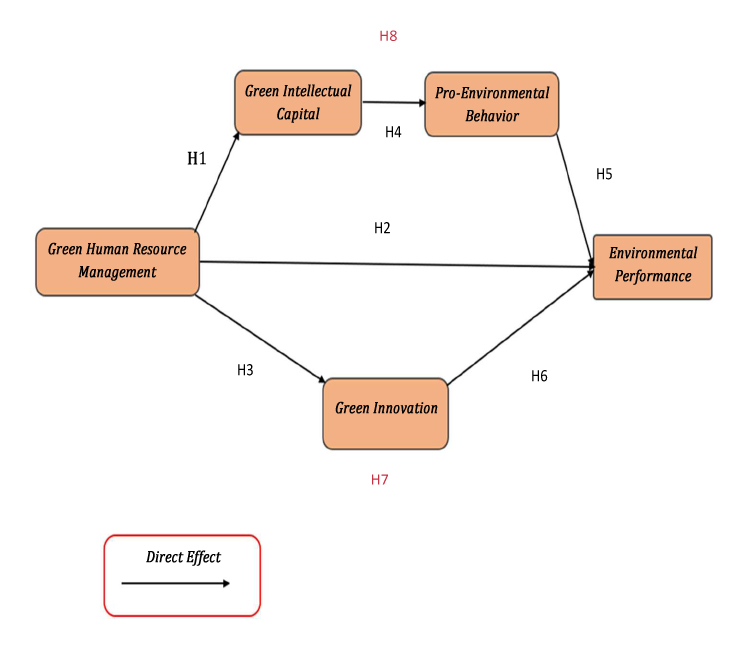 Figure 1. Conceptual framework.
A structured questionnaire was developed based on an extensive review of existing literature on GHRM and EP to gather data for this study. The questionnaire was carefully designed to include items that measure GHRM, GIC, PEB, GI, and EP. Prior to the main data collection, the questionnaire was reviewed by academic experts to ensure clarity and relevance. Additionally, a pilot test was conducted with 40 participants to assess the reliability and validity of the instrument. The results indicated high reliability, with Cronbach’s alpha scores exceeding 0.70 for all constructs, confirming that the items consistently measure the intended variables. The final survey questionnaire comprised three sections—the first welcomed participant involvement with confidentiality assurance; the second collected demographic data; and the third assessed GHRM, green catalysts, and eco-performance with 25 questions. There were at least five questions for each component (Table A1). We examined prior studies on GHRM, GIC, GI, PEB, and EP [39,58].
The primary data collection targeted managers and executives working in industrial organizations in Bangladesh. To efficiently reach respondents within the limited timeframe and resources, a convenience sampling method was employed. This approach involved selecting participants who were readily available and willing to participate through online channels, such as e-mail and social media platforms (e.g., Facebook and Instagram). The survey was accessible in English; however, to accommodate respondents’ preferences, there was an option to translate responses into Bangla if needed. The data were collected from October to November 2024, during which 435 questionnaires were distributed to middle- and upper-level managers across various companies and sectors. The participants were asked to rate their responses on a seven-point Likert scale, which allows for capturing nuanced attitudes and perceptions regarding their organization’s green practices and EP. Out of the 435 responses received, 41 questionnaires were discarded due to incomplete or inconsistent answers. The remaining 394 responses were deemed valid and used for further analysis. This resulted in a high response rate of approximately 94.9%, indicating strong engagement by participants. The demographic profile of the respondents revealed diversity in gender, age, education level, and organizational characteristics. Such diversity enhances the representativeness of the sample and strengthens the generalizability of the findings. The sample size of 394 respondents is considered adequate for the application of SEM, ensuring the statistical robustness needed to test the hypothesized relationships among the variables. To minimize potential biases, measures such as anonymity, confidentiality, and clear instructions were emphasized during data collection. A Harman’s single-factor test was conducted to check for common method variance, confirming that bias due to the method of data collection was not a concern in this study.
Data Analysis ToolsUsing Amos-24, SEM was utilized to study theoretical approaches. SPSS Statistics 24 displays demographics and descriptive statistics. The SEM demonstrated the relevance of the suggested paths and rated the measurement model’s correctness and reliability. This study used SEM because it establishes construct linkages and has strong predictive value for modeling exogenous variables [71]. The suggested model’s mediating effects are also assessed using the bootstrapping technique.
Common Method VarianceThis study used Harman’s single-factor test to conduct the common method variance test. If a factor explains more than 50% of the variation or all items come under the same factor, then there are common method variance problems [44,53]. The test findings demonstrate that there is no common method variance issue in the data, with the first factor accounting for 44.23% of the entire variance and only a small number of factors having an eigenvalue greater than 1 [54].
Table 1 displays the demographic data on the respondents’ gender in cumulative percentage, frequency distribution, and percentage. The table reveals that out of the 394 respondents, 39.1% (154) were women and 60.9% (240) men. In terms of age, 139 (35.3%) were 16–25 years old; 195 (49.5%) were 26–35 years old; 52 (13.2%) were 36–45 years old; and 8 (2.0%) were 46–55 years old. Most of the respondents were in the 26–35 age range. Regarding educational attainment, 2.3% (9) of the respondents were SSC holders; 14.2% (56 individuals) were HSC holders; 66.2% (261) were graduates; 14.0% (55 participants) had completed their post-graduation; and 3.3% (13 participants) had completed their PhD. Most of them were graduates. Reliability measures the consistency of the scales. The variables make dependability measurement easier.
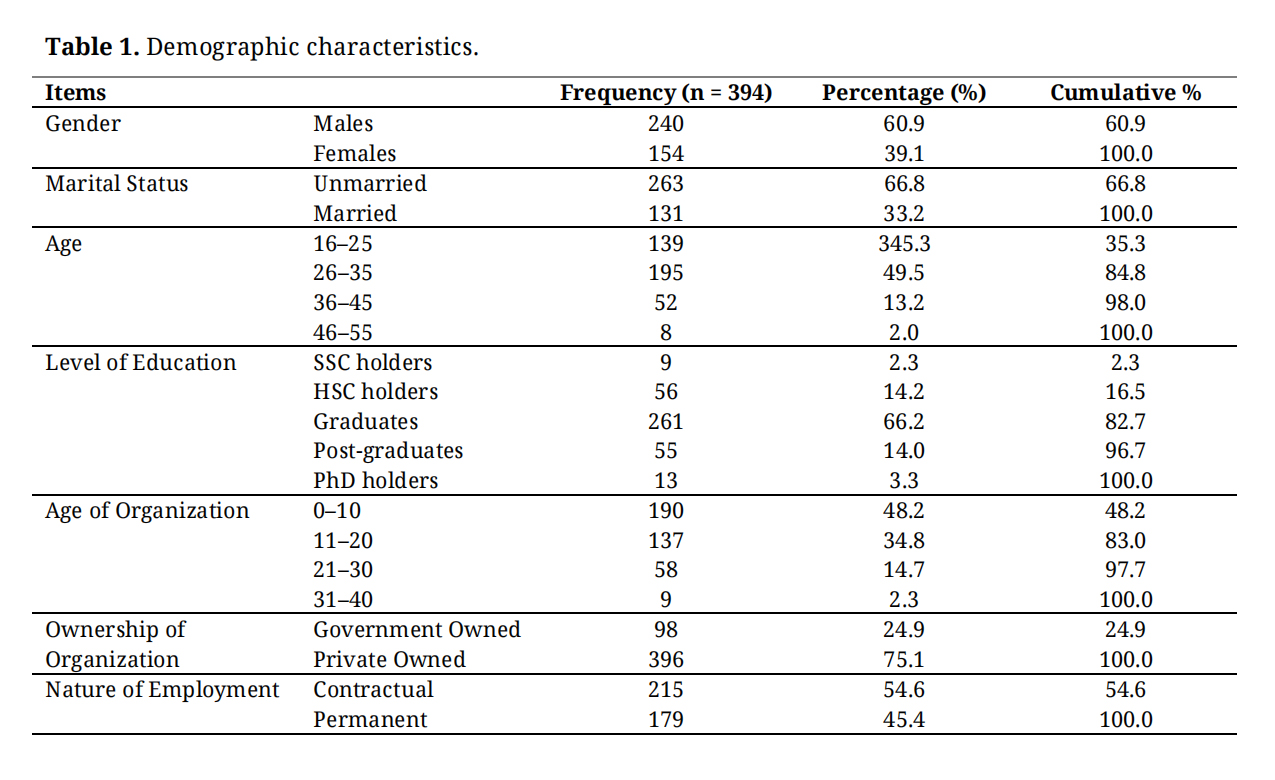 Table 1. Demographic characteristics.
The variables’ correlation matrix is displayed in Table 2. The table indicates that EP positively correlates with a GI, PEB, and GIC of 0.4420, 0. 451, and 0.353, respectively. It also correlates with GIC and GHRM (0.353 and 0.502, respectively). This indicates that it correlates with all factors.
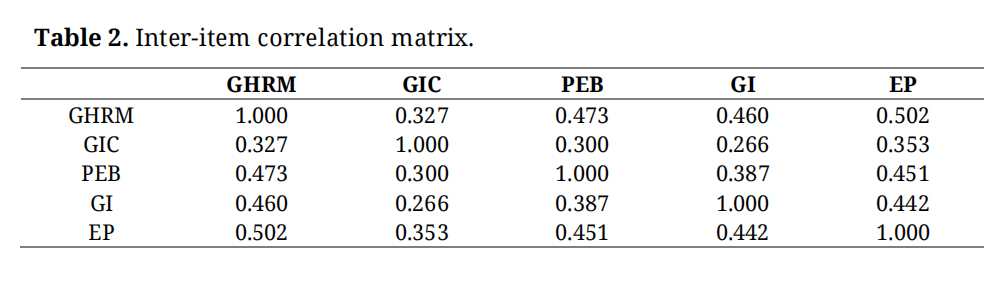 Table 2. Inter-item correlation matrix.
The 394 respondents in our sample meet the prerequisites for statistical analysis. The Cronbach alpha coefficient was used to assess the validity of the survey results for all categories of GHRM, GIC, GI, PEB, and EP. The overall Cronbach alpha for the inquiry is 0.895, which is quite good. However, the other variables’ Cronbach alphas also produced positive results, indicating that the item outcomes were extremely suitable for investigation (Table 3).
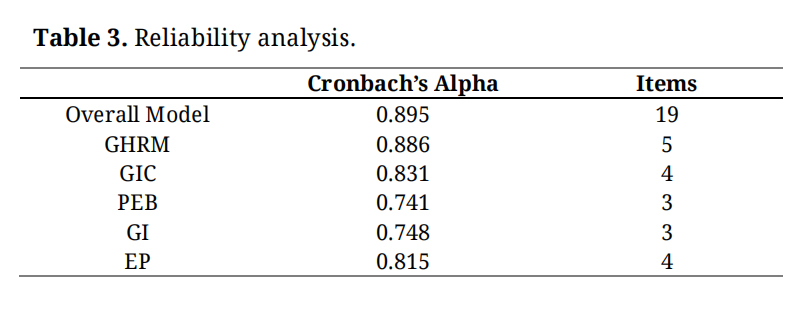 Table 3. Reliability analysis.
We used 394 responses for further data analysis after removing those with missing data and duplicates. All five variables’ item statistics are presented within the frameworks that were employed. There are statistics on every construct. The mean values of the constructs are as follows: 4.68, 4.73, 4.72, 4.75, 4.75, 4.64, 4.61, 4.74, 4.62, 4.74, 4.71, 4.74, 4.70, 4.72, 4.72, 4.72, 4.70, 4.68, and 4.71, with the accompanying standard deviations presented in the Table 4. The mean values indicate that most respondents agreed with the items. This implies that most respondents have generally good reactions to the variables under investigation. Data normality was confirmed using skewness and kurtosis. The skewness–kurtosis result is within a typical range of ±2.58. Thus, every item in the dataset for both samples had a normal distribution (i.e., <±2.58). The data were collected correctly, as depicted by the table’s skewness and kurtosis values, which are all within the allowed range. The results indicate the lowest and highest answer rates for each question.
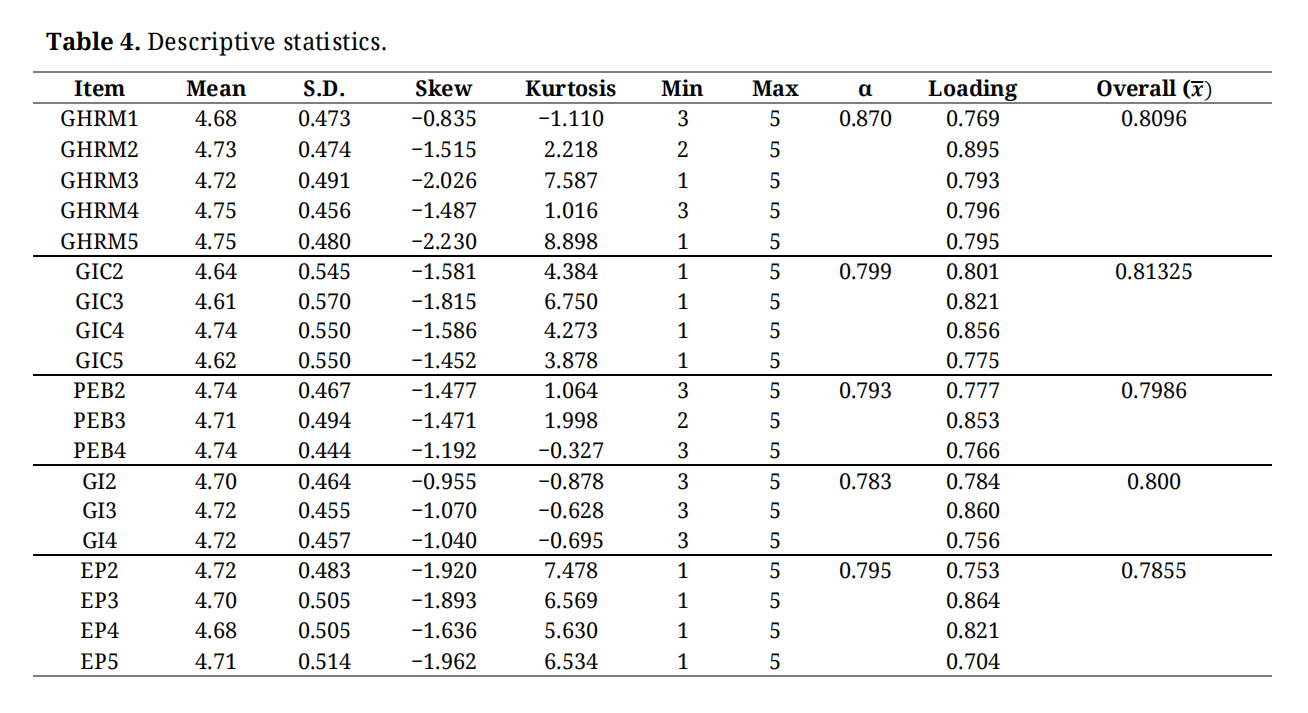 Table 4. Descriptive statistics.
This study employed confirmatory factor analysis subsequent to exploratory factor analysis. Figure 2 illustrates the measurement paradigm, while Table 5 elucidates its validity and reliability. The results indicate that the convergent validity ratings, ranging from 0.742 to 0.886, are above the recommended threshold of 0.70, signifying robust internal consistency. The average variance extracted (AVE) scores, ranging from 0.502 to 0.608, are above the acceptable boundary of 0.50 [74], while the factor loadings, ranging from 0.704 to 0.895 (Table 4), exceed the recommended limit of 0.70. Moreover, divergent and discriminant validity is established as the inter-construct correlation value is inferior to the square root of the AVEs, as indicated by Fornell and Larcker (1981) [75] and Hair et al. (2011) [76]. The VIF values, spanning from 1.167 to 1.504, indicate that the model is free from multicollinearity issues [50,76]. To assess the overall model fit, several widely employed fit indices were analyzed, including chi-square and the degrees of freedom ratio (χ2/d > 3), CFI (>0.90), GFI (>0.85), AGFI (>0.80), and RMSEA (<0.05). The model exhibited a satisfactory fit based on these criteria (Table 5) [54,75].
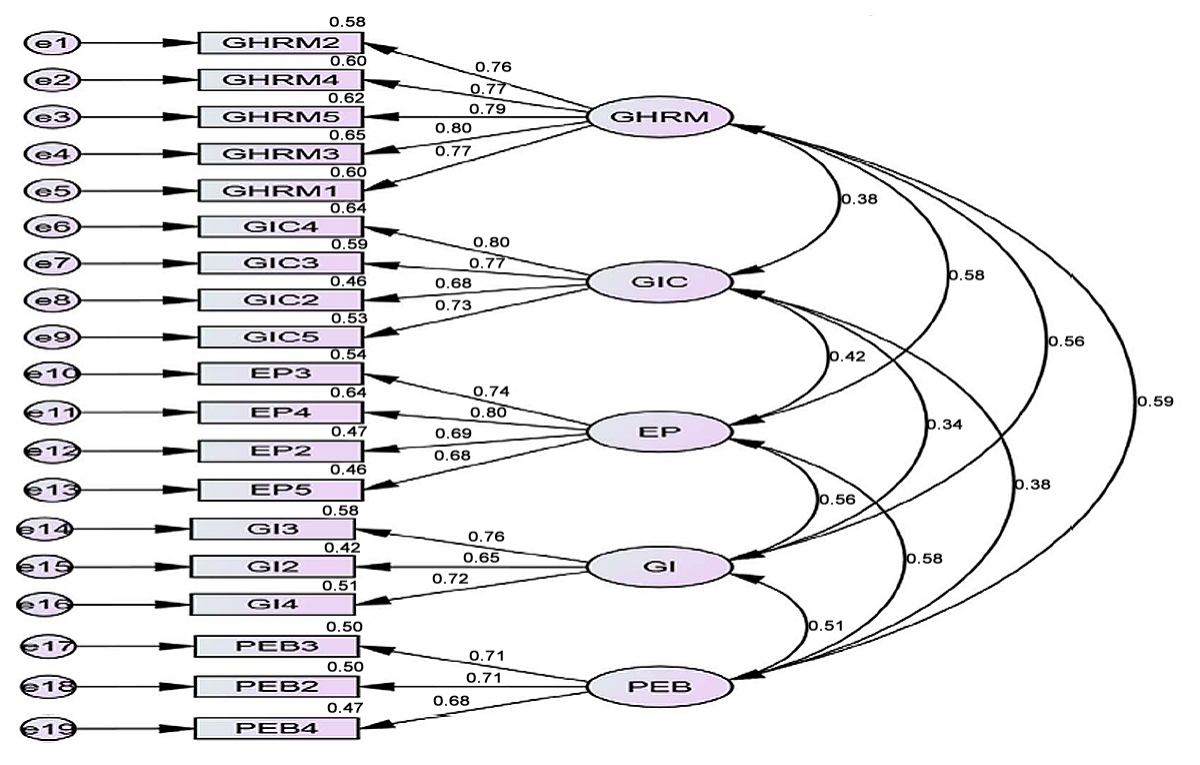 Figure 2. Measurement Model.
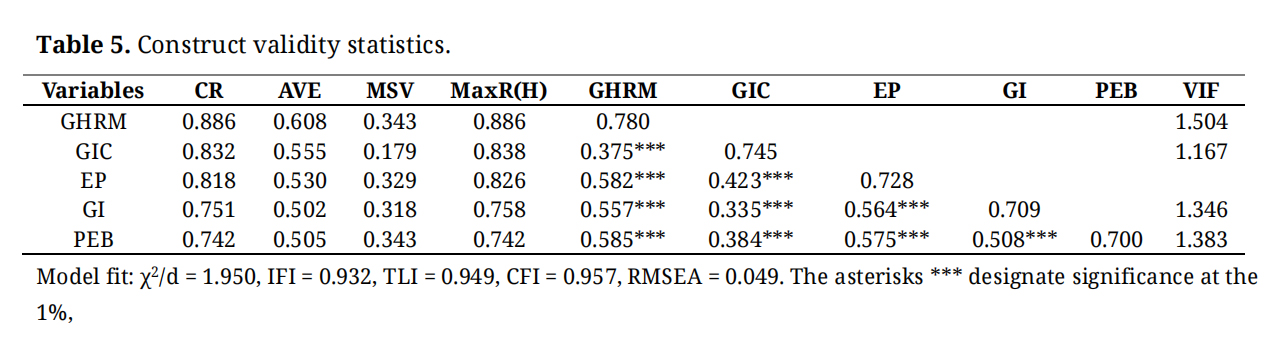 Table 5. Construct validity statistics.
Consistent with the measurement model fitness, SEM (Figure 2) was used to analyze the suggested paths. The SEM model fits the data reasonably well, as presented in Table 6 (χ2/d = 276.957, GFI = 1.950, AGFI = 0.881, CFI = 0.957, TLI = 0.947, IFI = 0.932, NFI = 0.917, RMSEA = 0.049). Except for H1, all the hypotheses (direct effect) in Table 6 have statistically significant support (p < 0.01). Impact of GIC (β = 0.44) on PEB. Regarding GIC and EP (β = 0.42) (β = 0.30), they significantly and positively affect each other. Further, GI (β = 0.56) has a considerable favorable impact on GHRM. Impact on EP of GI (β = 0.29), and PEB (β = 0.33). Additionally, the table indicates that the variance in bedtime procrastination and health have R2 values of GIC (R2 = 18%), GI (R2 = 32%), EP (R2 = 44%), and PEB (R2 = 19%). Table 6 presents the hypothesized pathway of SEM.
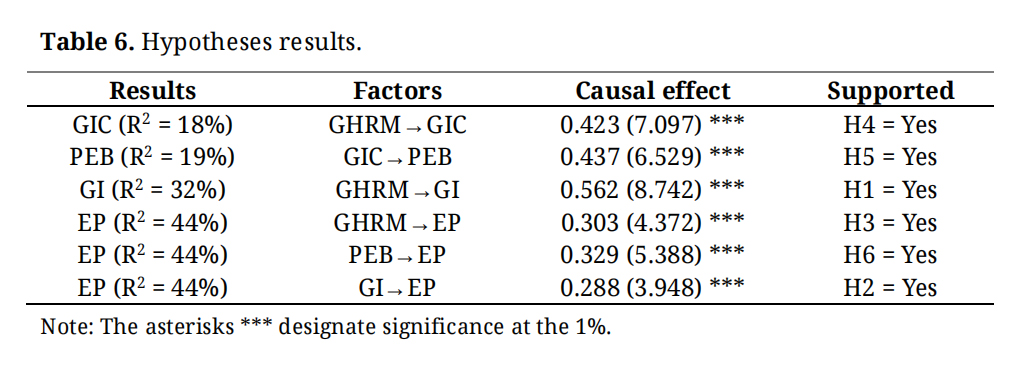 Table 6. Hypotheses results.
To assess the mediating effects in the model, this study bootstrapped using the suggestions made by Baron and Kenny (1986). Through a mediator, bootstrapping offers an indirect effect of the independent variable (Table 7). GI significantly mediates the relationship between GHRM and EP, and their indirect effect is GHRM→GI→EP = 0.272, which supports H7 in the bias-corrected model with a 95% confidence interval. The table also indicates that GIC and PEB significantly affect the relationship between GHRM and EP, and the indirect effect is GHRM→GIC→PEB→EP = 0.079, which supports H8. Thus, GIC and PEB serially mediate the relationship between GHRM and EP. Table 7 also indicates that the p-value of all the indirect effects is less than 0.05 and the lower and upper bounds of all mediations are positive, which means all relations are significant.
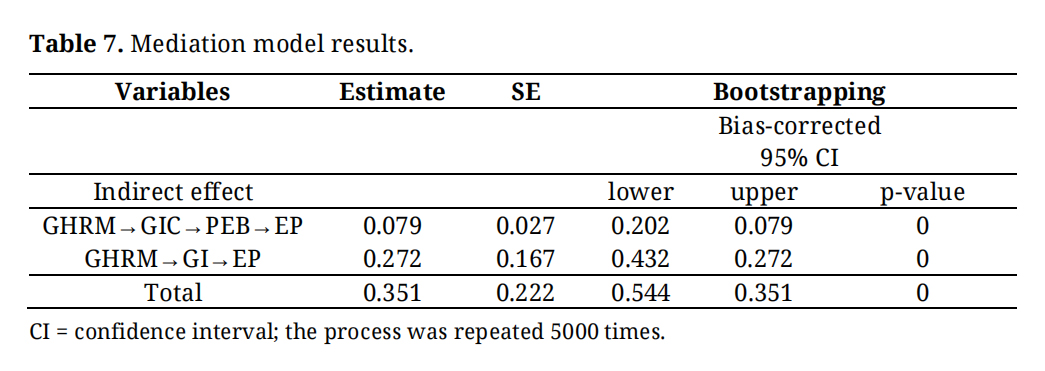 Table 7. Mediation model results.
This study aimed to explore the relationships between GHRM, GIC, PEB, GI, and EP in the context of Bangladeshi industrial firms. The findings support most of our hypotheses, revealing important insights into how green HR practices can drive environmental sustainability.
Figure 3 depicts that GHRM significantly and positively impacts EP, GIC, and GI, where the beta coefficients are 0.42, 0.30, and 0.56, respectively, and each relation is statistically supported (p < 0.05) (see Table 6, which supports H3, H4, and H1). Other studies have also found that GHRM has a positive impact on EP and GIC [22,36]. Here, H3 answers RQ2 and fills the research gap. Other researchers have found that GHRM positively and significantly affects GI [41,57], but this study’s findings indicate that GHRM significantly impacts GI.
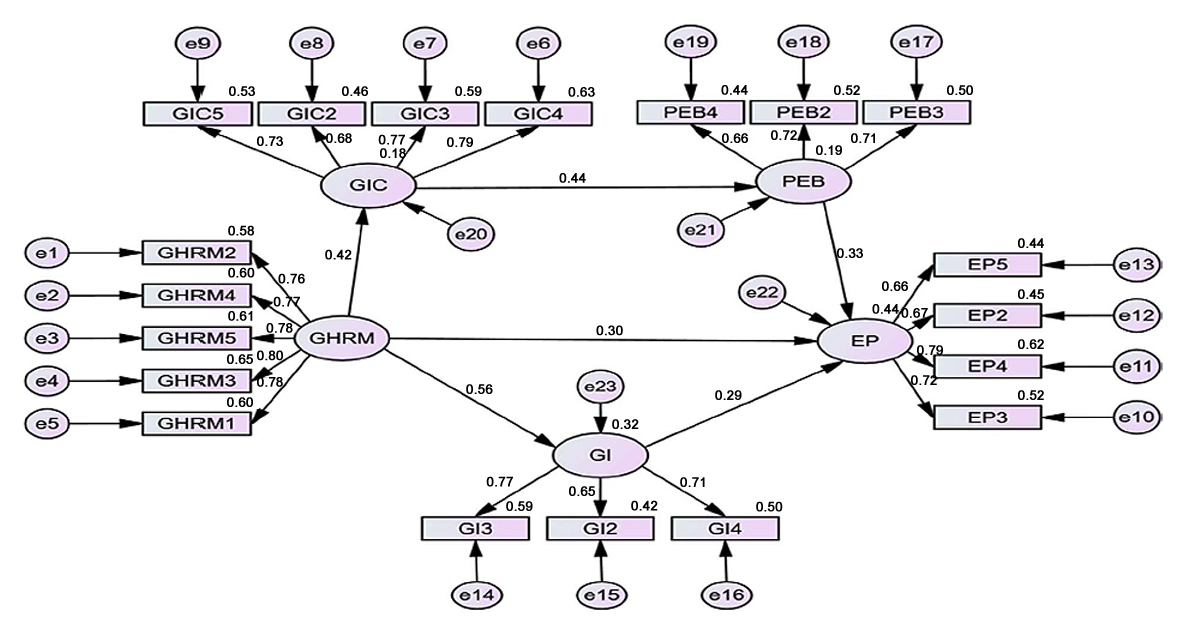 Figure 3. Structural Equation Model.
The positive effect of GHRM on EP (β = 0.30, p < 0.01) is significant, which is also consistent with the existing literature [22,38], and it proves that introducing green practices into HR policies can have a direct positive impact on EP. This highlights the strategic value of HR policies in ensuring organizational sustainability. It recommends that organizations that embrace green recruitment, training, and performance evaluation are in a better position to save on waste, save resources, and improve their market position, which is consistent with the RBV, which focuses on unique organizational capability. The high impact of GHRM on GIC (=0.42, p = 0.001) indicates that green HR practices play an important role in developing organizational intangible resources based on environmental knowledge and skills. The finding builds on the current literature [48] to highlight the importance of HRM in the process of developing green intellectual assets that are vital in generating long-term competitive advantage, particularly in developing economies such as Bangladesh, where the culture of environmental awareness is in its nascent stages. Notably, the positive relationship between GHRM and GI (0.56, p < 0.001) indicates that organizations that incorporate environmental values in their HR practices have higher chances of producing innovations to minimize negative environmental impacts. This proves that HRM is a critical source of GI, which may result in sustainable processes and product innovations that will be beneficial to the environment and organizational performance [62,71]. Our findings build on this perspective by demonstrating that, in a developing country context, these innovations are not merely good but are largely motivated by the HR practices.
Second, Table 6 reveals that PEB and GI significantly boost EP, with a beta coefficient of 0.33 and 0.29, respectively, and a p-value below 0.05, supporting H2 and H6. This finding aligns with previous studies [26,31,47]. Moreover, the mediating role of GI (H7) in the relationship between GHRM and EP indicates the significance of the process of innovation as a means of transforming HR policies into a concrete environmental gain. This is consistent with other studies [52] that found GI as one of the most important pathways to attain desired sustainability objectives. It recommends that companies should not only cultivate green skills but also focus on GI projects to make the most out of the environment.
Third, the moderating values of GIC and PEB were of particular interest. In the serial mediation analysis (H8), GIC is found to moderate PEB (=0.44, p < 0.001), which in turn increases EP (=0.33, p < 0.001). Table 6 indicates that GIC positively impacts PEB, where the beta value is 0.44 (see Figure 3), and thus H5 is statistically supported (p < 0.05). Other researchers have found that GIC positively and significantly affects PEB [47]. This is consistent with the SCT [33] which advances that knowledge and skills (GIC) influence behaviors (PEB) and thus influence organizational results. In practice, it implies that companies need to work on building environmental knowledge and skills of employees to foster proactive, eco-friendly actions and thus enhance the overall EP.
Lastly, Table 7 indicates that GI, GIC, and PEB have an indirect effect on GHRM and EP. This table also reveals that all the indirect effects are positively and statistically supported (p < 0.05). Here, H7 and H8 are supported. Other studies have also had this similar result [33,47,49,58]. Here, some authors have found that GI significantly mediates the relationship between GHRM and EP, thus answering RQ1. Table 7 also indicates that GIC and PEB significantly serially mediate (p < 0.05) the relationship between GHRM and EP (supporting H8). Further, the table indicates that GI significantly mediates (p < 0.05) the relationship between GHRM and EP (supporting H7). Here, we answer RQ1 and fill in the research gap. Other studies have also found that GI significantly mediates the relationship between GHRM and EP [49].
The main value of this study is that it was the first to explicitly examine how GI, GIC, and PEB mediate the GHRM–EP relationship. These consecutive mediation lines of action make the study contribute to the theoretical knowledge of how HRM practices lead to EP. Further, the emphasis on the Bangladeshi industrial setting provides useful information to practitioners and policymakers who would pursue sustainable practices in developing economies. The results emphasize the significance of encouraging not only GHRM practices but also improving GIC and greener behaviors of employees to achieve long-term environmental objectives.
In a broader sense, the implications of these results for managers and policymakers in developing countries are high. The findings support the RBV, which emphasizes the role of intangible resources, such as GIC and PEB, in the creation of sustainable competitive advantage. Although the results are encouraging, the investigation of alternative mediators (e.g., green commitment) or moderators (e.g., environmental consciousness) may be used to further understand the mechanisms underlying GHRM and EP. Moreover, longitudinal studies might offer information about the changes in such relationships over time. Overall, the present study contributes to the existing literature as it empirically proves the importance of GHRM in ensuring environmental sustainability through GIC, GI, and PEB. Such lessons can inform organizations to develop good internal policies to meet environmental requirements and realize sustainable development.
This study contributes to the literature on improving EP in the Bangladeshi industry. Environmentally friendly HR approaches increased factory workers’ GIC. Hoteliers can increase their GIC by hiring responsible staff, training and developing them, and going green. When they acquire the knowledge, skills, talents, and methodologies, GIC would push employees to be environmentally friendly. This will boost EP by encouraging greener behavior. The study suggests that intellectual capital may make hotel staff more environmentally friendly, thereby improving business performance. The study found that GHRM improves environmental processes. To support SCT, the study examined GHRM activities that may build intellectual capital rather than reinforce behaviors. Our study reveals that GHRM hires, develops, and retains green workers. GIC may help companies compete and enhance their environment. The RQ answers and results would benefit industrial companies. GIC should be used strategically by manufacturing business owners and managers to meet environmental goals. GHRM can improve GIC and EP if senior management supports it.
Theoretical ImplicationsOur work offers a holistic interpretation of empirical data on GHRM, PEB, GIC, GI, and EP, thereby contributing to the literature to benefit scholars, professionals, and policymakers. This helps determine the relationship between GHRM and EP through GIC, PEB, and GI. HRs’ rarity, worth, non-repeatability, and exclusivity give organizations a competitive edge, according to the RBV [22,58]. Organizations improve their EP by reducing resource use through GHRM. Thus, GHRM is needed to protect the environment [61].
This study contributes to the literature on GHRM and EP by explaining the underlying relationship with two mediating variables and providing empirical evidence of a process. Thus, this study’s mediation method provides a comprehensive framework for GHRM practices’ environmental effect analysis. The cognitive theory was used to study environmental strategy and efficient management [38], finding that GHRM, GI, GIC, environmental strategy, and PEB affect industrial EP. GI, intellectual capital, and pro-environmentalism help major industrial corporations function environmentally.
Practical ImplicationsThis study has major implications for pro-environmental managers. It starts by integrating GHRM practices into an organization’s long-term plan for sustainable growth. Organizations may benefit from environmental HRM strategies to encourage individual environmental behavior. GHRM should include commitment and behavior. Environmental criteria should be included in job descriptions, designs, and recruitment messages. Candidates may be tested on environmental understanding, care, and dedication during interviews. Employees must understand green goals and duties. Performance management systems can be improved by adding corporate environmental management objectives and targets, offering staff regular feedback to accomplish environmental goals, and including EP as a performance indicator. Companies must also let employees use their training. Such opportunities will boost their GIC, promote PEB, and increase industrial EP. The empirical evidence reveals that GHRM methods contribute to GIC, thereby helping managers build intellectual capital.
Limitations and Future Research DirectionThis interesting work has numerous drawbacks that warrant further study. Countries, sectors, and organizations manage the environment and HR differently [58]. Our study focused on Bangladesh’s industry. GHRM practices in emerging and developed countries’ manufacturing and nonmanufacturing sectors limit this study. Future studies may include nonmanufacturing industries and affluent nations in our conceptual framework. In addition, perceptual or primary data may be incomplete. Additional secondary environmental data from organizations might improve the study. Like most empirical surveys, only some selected variable determinants were explored and quantified, although both can exist in the scientific literature and various ones can be implemented. To better understand how GHRM practices impact PEBs, future research should examine other mediators (e.g., green commitment, job satisfaction, and green lifestyle) and moderators (e.g., environmental consciousness and green self-efficacy).
This study approval constituted ethical clearance by the Faculty of Business Studies, Barishal University, Bangladesh on dated 19/09/2024 under the memo no. IQAC/TEM/EP-00208/19-08-2024.
Written informed consent was obtained from all individual participants regarding the collection, storage, and use of their given information for research purposes.
Data will be provided by Corresponding Author upon reasonable request.
Conceptualization, PA and AAM; methodology, AAM; software, PA; validation, MAIG and AA; formal analysis, PA, AAM; investigation, MBA, JD and ARbSS; resources, MAIG, AA, MTI, ARbSS and JD; data curation, MAIG, AA, and AAM; writing—original draft preparation, PA, MAIG and AAM; writing—review and editing, PA, MAIG, AA, MBA, MTI, ARbSS, and AAM; visualization, PA, MAIG, AA and AAM; supervision, AAM; project administration, MAIG; funding acquisition, MBA, AA and ARbSS. All authors have read and agreed to the published version of the manuscript.
Authors are declaring there is no conflict of interest
The authors extend their appreciation to the Deanship of Research and Graduate Studies at King Khalid University for funding this work through a Large-group Research Project under grant number (RGP.2/146/47). And partially funded by Ahsanullah University of Science and Technology, Dhaka, Bangladesh.
This research was supported by the University of Debrecen Program for Scientific Publication and the INTI International University, Malaysia.
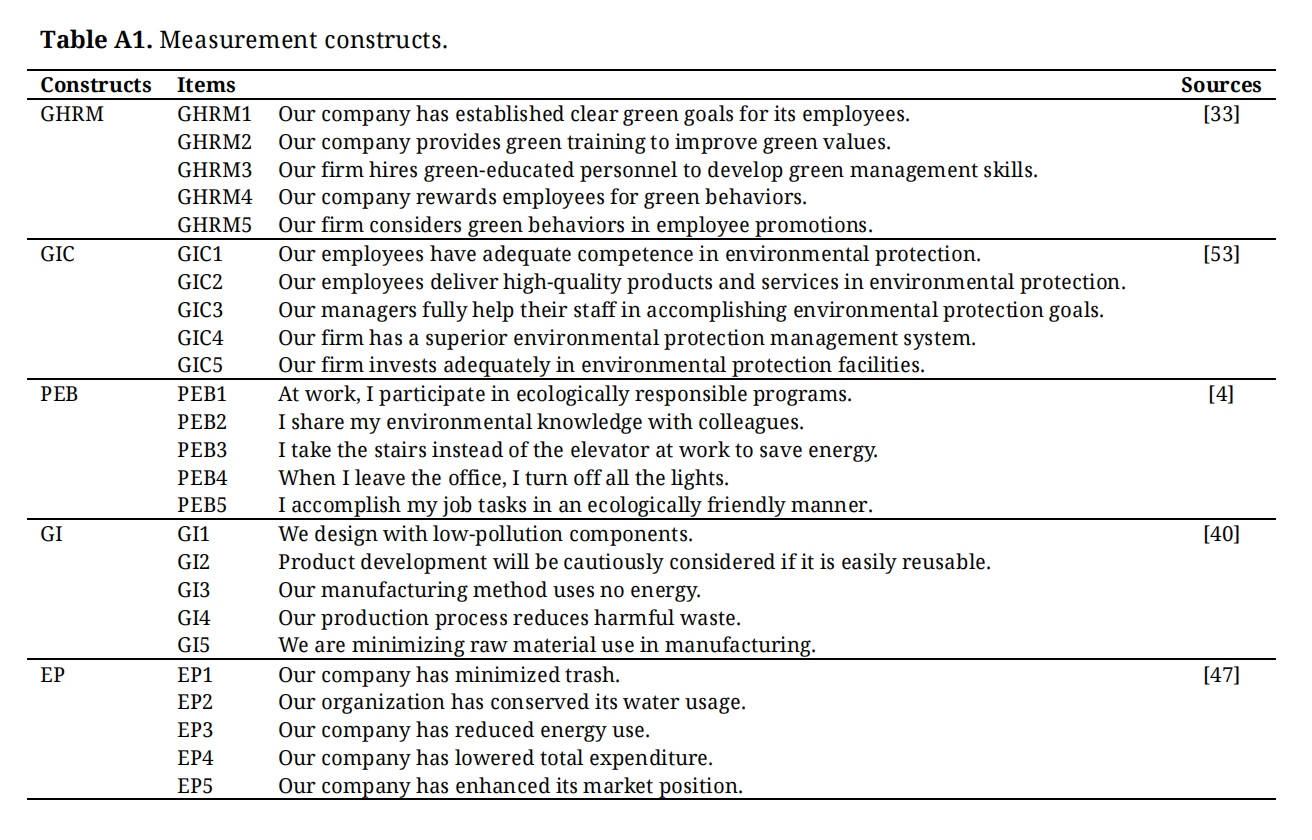 Table A1. Measurement constructs.
1.
2.
3.
4.
5.
6.
7.
8.
9.
10.
11.
12.
13.
14.
15.
16.
17.
18.
19.
20.
21.
22.
23.
24.
25.
26.
27.
28.
29.
30.
31.
32.
33.
34.
35.
36.
37.
38.
39.
40.
41.
42.
43.
44.
45.
46.
47.
48.
49.
50.
51.
52.
53.
54.
55.
56.
57.
58.
59.
60.
61.
62.
63.
64.
65.
66.
67.
68.
69.
70.
71.
72.
73.
74.
75.
76.
Gazi MAI, Al Masud A, Islam MT, Amin MB, Amani A, Akhter P, et al. How Green Human Resource Management Drives Environmental Performance: The Role of Green Intellectual Capital and Employee Eco-Friendly Behavior. J Sustain Res. 2026;8(2):e260056. https://doi.org/10.20900/jsr20260056.

Copyright © Hapres Co., Ltd. Privacy Policy | Terms and Conditions


